


Few modern TaylorMade putters have influenced putter design as much as the Spider. What began as an unconventional oversized mallet has developed into an extensive family of high-stability designs used by major champions, leading PGA Tour players and everyday golfers.
The story of how TaylorMade Spider putters have evolved over the years is essentially one of refinement. The early models pursued forgiveness through size and perimeter weighting. Later generations became progressively more compact, introduced better alignment systems and offered different centre-of-gravity positions and hosels. Today's Spider range extends that philosophy into advanced torque-resistant designs.
The result is a Spider franchise that has helped blur the traditional distinction between blade putters and mallets. Golfers can now choose a spider with substantial stability and forgiveness while retaining the compact shape, toe hang or blade-like feel that suits their stroke.
Golf Gear Direct carries current TaylorMade putters, giving golfers access to the latest generation of the Spider concept alongside TaylorMade's wider equipment range.
The story starts with the original Monza Spider, which appeared in the late 2000s.
TaylorMade's historical specifications list the Rossa Monza Spider and Rossa Monza Itsy Bitsy Spider among its 2008 products. The original design looked radically different from the traditional mallet shapes golfers were accustomed to seeing.
Rather than trying to disguise its size, the original Spider used a large footprint and multi-material construction to push weight towards the perimeter. The objective was straightforward: increase the moment of inertia so the head resisted twisting when golfers missed the centre of the face.
That spider stability was particularly valuable on off-centre strikes, where a conventional compact putter could lose more speed and directional control.
It established a design principle that still defines the modern Spider: distribute head weight intelligently to produce a more stable impact.
One obvious limitation of the early Monza Spider was its size.
TaylorMade responded with the Itsy Bitsy Spider, reducing the footprint while retaining the basic high-MOI concept. This was an important step because it demonstrated that golfers wanted Spider's forgiveness without necessarily wanting an oversized head behind the golf ball.
The Itsy Bitsy therefore anticipated a trend that would become increasingly important across the following decade: making mallet putters look cleaner and more compact without surrendering their stability advantage.
This gradual transition from oversized shapes to more refined head shapes has become one of the defining themes of the Spider line.
When the original Spider appeared, blade putters still dominated much of professional golf.
That balance has changed dramatically. TaylorMade has previously noted that more than 60% of players on the PGA Tour had moved towards a mallet-style putter, compared with a time when the numbers were effectively reversed.
Spider was not solely responsible for that transition, but it became one of its most visible symbols.
A mallet could provide substantial perimeter weighting and maximum stability while manufacturers refined the appearance, sound and feel enough to satisfy elite golfers.
The mallet was crucial. Tour pros do not simply need forgiveness. They need precise feedback, predictable ball speed, dependable alignment and a head shape that inspires confidence on everything from short putts to mid-range putts.
Spider gradually evolved to address all of those requirements.
The Spider Tour era marked a major expansion of the franchise.
The Spider Tour Red and Tour Black helped move Spider towards a cleaner, more tour-orientated appearance. High-profile adoption also transformed perceptions of what a mallet could look like in the hands of an elite player.
Players including Jason Day and Dustin Johnson became strongly associated with Spider designs. Day's putting performances helped establish the model at the highest level, while Johnson's use of a Spider Tour reinforced its credibility among golfers who previously associated elite putting predominantly with blades.
The Tour Red and Tour Black period helped prove that stability did not need to come at the expense of a relatively simple appearance.
From there, the Spider name became far more than one unusual putter. It became an entire product family.
Face technology became another important part of Spider's evolution.
Current Spider Tour models use TaylorMade's TPU Pure Roll insert, made from Surlyn and aluminium. Its grooves are angled downwards at 45 degrees to encourage forward roll while contributing to the softer sound and feel associated with the modern design.
Creating a consistent roll matters because a putt that begins skidding or bouncing excessively can make distance control less predictable.
Modern sound-dampening materials and inserts have also allowed TaylorMade to refine acoustic feedback. This matters more than it might initially appear: sound strongly influences a golfer's perception of whether a putter feels soft, firm or responsive.
The evolution of Spider has therefore involved more than making the head more forgiving. TaylorMade has continually worked on how the putter feels and sounds at impact.
The Spider X represented another important stage in the evolution of the line.
By this point, TaylorMade no longer needed an enormous head to generate the desired stability.
More sophisticated multi-material construction allowed engineers to manipulate weight distribution while reducing the overall footprint.
That meant Spider X could offer the visual benefits of a more compact shape alongside the forgiveness expected from the franchise.
This development reflects a broader change in golf equipment engineering. Early high-MOI designs often achieved stability simply by becoming larger. Modern materials allow manufacturers to position mass much more deliberately.
The result is a putter that can look relatively compact at address while still placing significant mass away from the centre of the face.
Another major advancement was TaylorMade's True Path alignment system.
True Path creates strong visual contrast between the putter and golf ball, helping golfers see the intended starting line more clearly at address. TaylorMade describes the technology as a way to define face aim and create a visual continuation of the line between ball and target.
Alignment has become one of the most important advantages of modern mallets.
A golfer can make an excellent stroke and still miss if the putter face begins fractionally open or closed. A larger mallet provides manufacturers with more physical space to create meaningful visual references on the crown.
That is something a traditional blade cannot reproduce as easily.
Modern Spider design is no longer based around one head for every golfer.
The Spider Tour family has included Tour, Tour X, Tour V, Tour Z and Tour S configurations. These models use different centre-of-gravity positions and head proportions to create distinct performance characteristics.
The standard Spider Tour retains the familiar Spider profile and positions the CG farther back for substantial stability.
Spider Tour X moves the centre of gravity farther forward, creating a blend of mallet stability and a more blade-like response.
Tour V and Tour Z provide additional shapes and CG locations, while Spider Tour S uses a larger construction and is available in configurations designed around additional stability and counterbalancing.
This makes the modern Spider Tour series considerably more sophisticated from a fitting perspective than the original one-size-fits-most concept.
The Spider Tour X has become one of the most important models in the modern range.
Its centre of gravity sits farther forward than the standard Spider Tour, helping it deliver the responsive characteristics preferred by golfers accustomed to blades while maintaining the visual alignment and stability advantages of a mallet.
That combination has proved particularly influential on Tour.
Scottie Scheffler's move from a blade-style putter into a Spider Tour X demonstrated exactly why the design exists. His early prototype moved weight towards the face to reproduce more of the sensation he associated with a blade, while the larger head made alignment easier.
It represents the broader evolution of Spider perfectly: maximum stability no longer requires golfers to accept a completely unfamiliar feel.
Few equipment changes have attracted as much attention as Scottie Scheffler moving into the Spider Tour X.
Scheffler began using an L-Neck Spider Tour X in competition in 2024 after extensive testing. The putter incorporated an L-neck hosel, full sight line, true path alignment and pure roll insert.
The change quickly became associated with an extraordinary run of success. During 2024 he won the Masters, THE PLAYERS Championship, Olympic gold and the TOUR Championship using the Spider Tour X.
By September 2025, PGA Tour reporting credited TaylorMade Spider putters with 28 Tour victories since the beginning of 2024.
Scheffler's success is particularly significant, as he had spent much of his career favouring blade putters. His transition illustrates how far the spider concept has evolved.
Rory McIlroy is another major name closely associated with the Spider family.
TaylorMade's current fitting guidance identifies the small slant hosel as the configuration played by McIlroy. This setup creates toe hang, making it suitable for golfers whose putting strokes include greater face rotation.
The fact that golfers such as McIlroy and Scheffler can use different hosel configurations within the same broad family illustrates how much fitting flexibility has improved.
Instead of asking whether a golfer is a "Spider player", it now makes more sense to ask which Spider head, CG location and hosel combination suits their stroke.
Hosel design has become a key part of modern putter fitting.
A small slant hosel or a short slant hosel generally creates additional toe hang. This can suit golfers whose stroke naturally arcs and rotates the face.
A double-bend shaft can produce a more face-balanced configuration for players whose stroke travels more directly back and through.
The L-Neck hosel available in Spider Tour X gives golfers another option, particularly those transitioning from a traditional blade. TaylorMade specifically introduced the retail L-neck configuration following Scheffler's success with his customised version.
Choosing the right horse can therefore be just as important as choosing the correct head weight or head shape.
Despite all the changes, the core Spider principle remains remarkably consistent.
Perimeter weighting moves mass away from the centre of the head, increasing resistance to twisting.
When a golfer strikes a putt away from the sweet spot, a more stable head can preserve face orientation and speed more effectively. That helps maintain predictable distance and direction on off-centre strikes.
Modern Spider Tour construction uses a thin-wall undercut and steel wireframe to enable precise CG placement and improve stability and forgiveness.
This is essentially a more sophisticated version of the idea behind the original Monza Spider.
The objective has stayed the same. The engineering used to achieve it has become considerably more advanced.
Personalisation has also become more important throughout the Spider era.
TaylorMade has previously offered MySpider programmes allowing golfers to personalise aspects such as crown and wing colours, paint fills, hosel configurations and weighting.
This development reflects the way the putter market has changed. Golfers increasingly view a putter as one of the most personal golf clubs in the bag.
Appearance matters because golfers spend considerable time looking directly at the putter at address. Confidence in its shape, alignment marks and finish can influence how naturally the player aims.
Performance remains the priority, but personalisation gives golfers another way to make the club feel genuinely their own.
The newest chapter moves Spider into zero-torque technology.
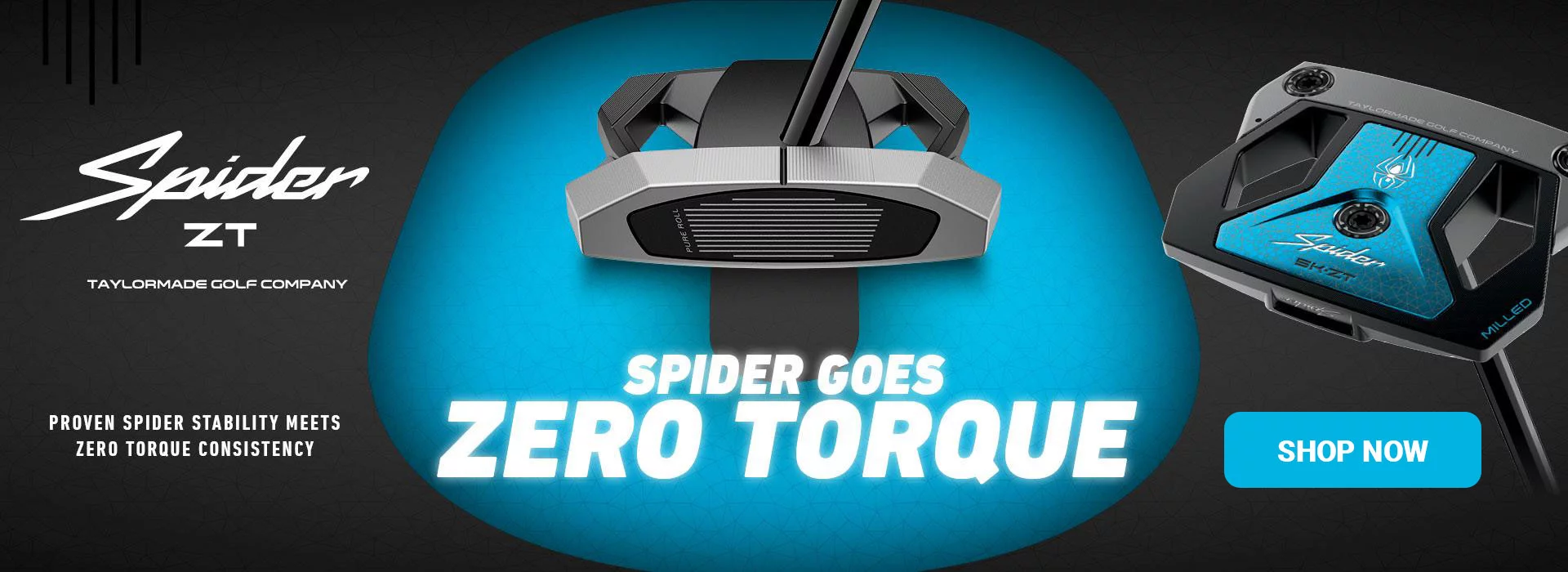
Golf Gear Direct currently offers TaylorMade's Spider 5K-ZT family, including standard and counterbalanced configurations. These models use a toe-up, face-balanced concept designed to reduce unwanted face rotation through the stroke and promote more consistent delivery.
Zero-torque concepts seek to position the putter so that it naturally resists twisting rather than requiring the golfer to manipulate the face square.
This is an interesting development because it pushes Spider's original obsession with stability into a new area.
The original spider was designed primarily to resist twisting at impact. Modern zero-torque designs also seek to control how the face behaves throughout the stroke.
Golfers interested in this latest development can explore the TaylorMade Spider 5K-ZT range at Golf Gear Direct.
From a fitting and engineering perspective, modern Spider putters provide considerably more choice.
The original Spider was innovative because its oversized structure generated substantial stability. Today's designs can create comparable or greater stability through sophisticated weighting, wireframe construction, different CG positions and carefully engineered materials.
Modern golfers can also select between different head shapes, toe-hang characteristics, alignment systems and hosel styles.
The result is not just "more forgiveness"; it is more targeted forgiveness.
A golfer who likes substantial mallet stability can choose one configuration, while someone seeking a more compact head and blade-like feel can move towards Spider Tour X.
That versatility is arguably the greatest advancement the franchise has made.
The answer depends primarily on your stroke and what you want to see at the address.
Golfers seeking maximum stability should prioritise the larger, more stable configurations within the Spider family.
Players moving from blade putters may find Spider Tour X particularly appealing because its more forward CG provides a responsive sensation while retaining mallet-style alignment and forgiveness.
If you naturally rotate the face during the stroke, a small-slant configuration with toe hang may be appropriate. Golfers with less face rotation may prefer a face-balanced or double-bend design.
Players interested in minimising face rotation should also consider the latest zero-torque Spider designs.
Ultimately, the new putter that produces the most confidence and repeatable start line is more valuable than simply choosing the model used by a particular professional.
The Spider has survived for so long because TaylorMade has continually changed the product without abandoning its original purpose.
The Monza Spider pursued stability through a large footprint. Itsy Bitsy made the concept more compact. Spider Tour increased its credibility among elite golfers. Spider X refined the shape and weighting further, while True Path and Pure Roll improved alignment and roll characteristics.
The current TaylorMade Spider Tour family takes that evolution further through different centre-of-gravity locations and hosel configurations. Zero-torque technology now represents another potential direction for the franchise.
Through every generation, the underlying objective has remained remarkably consistent: help golfers start more putts on their intended line and maintain predictable performance when contact is imperfect.
Understanding how TaylorMade Spider putters have evolved over the years shows just how influential the franchise has been in modern putter design.
What began with the oversized original Monza Spider has evolved into a diverse range of sophisticated mallets capable of fitting very different putting strokes. Perimeter weighting and high stability remain central to the concept, but technologies such as Pure Roll, True Path, forward CG positioning, multiple hosels and zero-torque construction have transformed how that performance is delivered.
The success of players including Rory McIlroy and Scottie Scheffler has further demonstrated that modern mallets can offer elite performance without sacrificing the precision and feedback demanded by the world's best golfers. Scheffler's switch from a blade to Spider Tour X is perhaps the clearest modern example of that evolution.
For golfers looking to upgrade their performance on the putting surface, Golf Gear Direct offers TaylorMade putters and the latest Spider models alongside a comprehensive range of golf equipment from leading brands.